


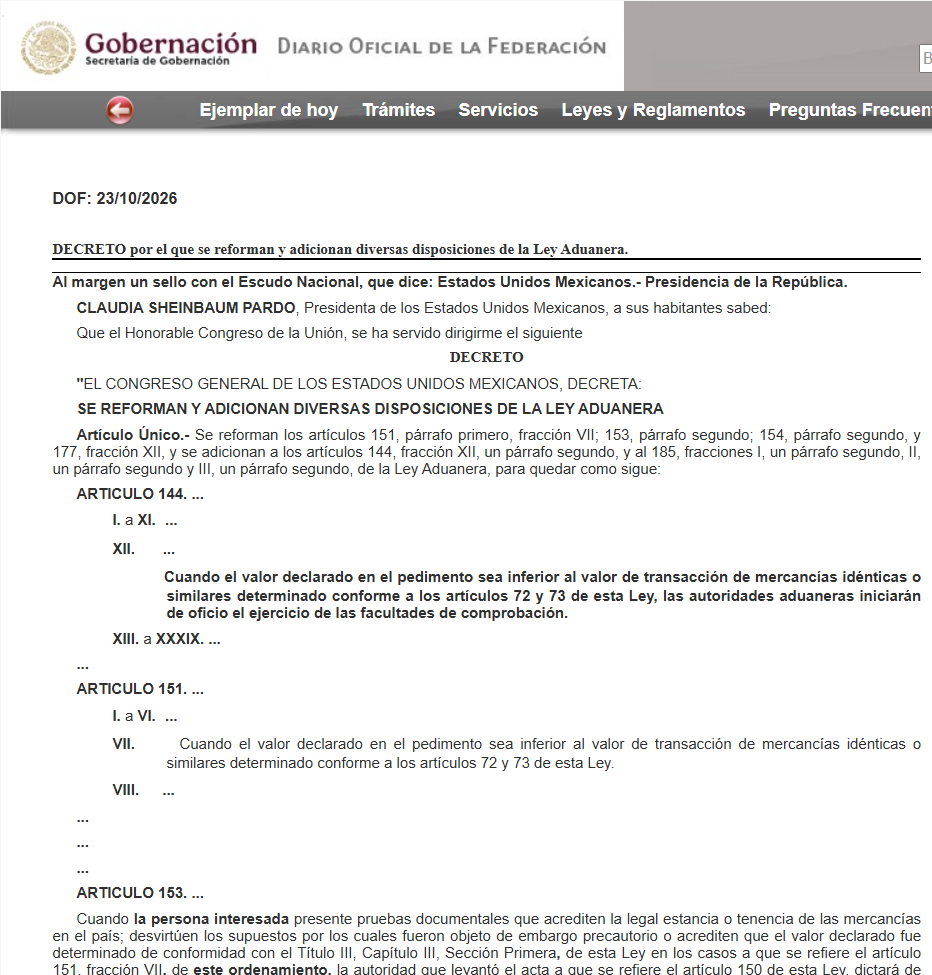
Under the new second paragraph of Article 144, section XII, customs authorities must initiate verification procedures on their own initiative when the declared value is below the transaction value of identical or similar goods, while Article 151, section VII adds the same circumstance as a legal ground for precautionary seizure. Compared with the current text, the amendment also eliminates the 50% minimum difference requirement and the exception under which goods subject to estimated prices could avoid seizure when the guarantee contemplated by Article 86-A had been posted; the previous route of posting a guarantee to avoid seizure no longer applies automatically.
It is worth noting that the benchmark is not a reference or estimated price set by customs, but the transaction value of identical or similar goods determined under Articles 72 and 73 of the Customs Law, which draw on the WTO Customs Valuation Agreement. The gap itself therefore no longer needs to reach a specific magnitude to justify a seizure; importers whose legitimate commercial arrangements — related-party transactions, volume discounts or differences in commercial level — result in declared prices below comparable prices observed by the authorities may still fall within the scope of seizure. The mechanism applies only to goods for which the Ministry of Finance and Public Credit (SHCP) has not set estimated prices.
For goods not subject to estimated prices, Article 154 provides that importers may request substitution of the seizure within 10 business days of notification of the start of the administrative procedure: where the value difference is below 20%, a cash deposit or a deposit in a customs guarantee account is accepted; where the difference reaches or exceeds 20%, only a cash deposit is accepted, covering the import duties and trade-remedy duties such as anti-dumping duties payable on the difference. Article 153 provides that where the importer can show the declared value was determined in accordance with the law, customs must issue a ruling without penalties and return the goods or the deposit. The mechanics of these deposits will be set out in provisions to be issued by the competent customs authorities.
Article 177, section XII lowers the threshold at which an infraction is presumed from 50% to 20%: where an audit finds the declared value to be 20% or more below the transaction value of identical or similar goods, and that undervaluation would have resulted in the total or partial omission of import duties or trade-remedy duties had the goods been definitively imported, the infraction is presumed to have been committed. Article 185 substantially raises fines for certain violations involving hydrocarbons and petroleum products, from the previous MXN 2,640–7,560 (about USD 142–407, at MXN 18.58 per dollar) to 50%–100% of the goods’ commercial value.
As for the transition, customs authorities must issue general rules before January 1, 2027 identifying the goods to which precautionary seizure will apply directly when the declared value is below the transaction value of identical or similar goods, together with the applicable procedures; for goods not listed, the rules will set the percentage threshold of value difference that justifies a seizure. In other words, how strictly the reform is enforced at the outset will depend on those lists and thresholds rather than on a zero-tolerance standard applied to all imports.


bj.info@mexcham.org