

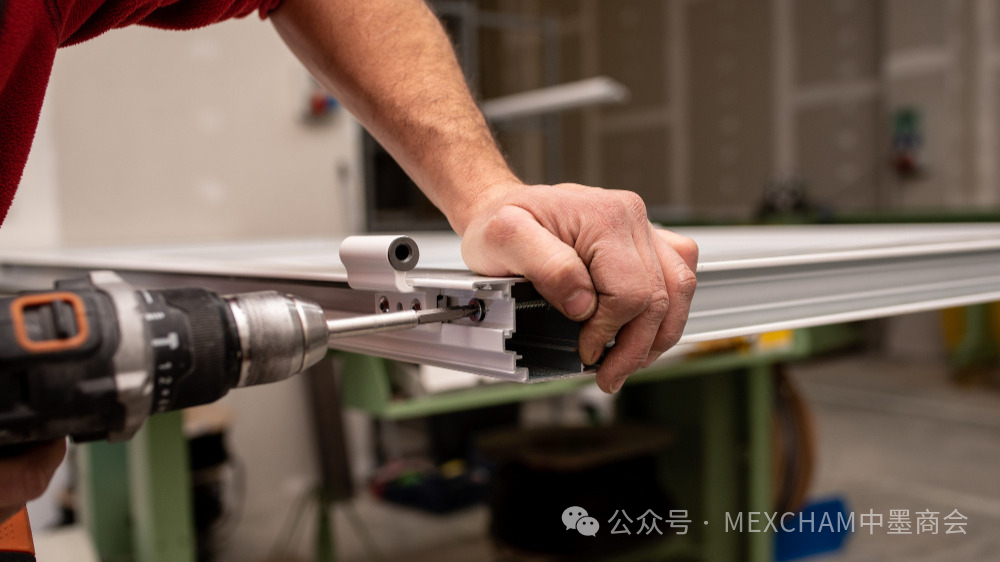
Mexico’s aluminum industry processes around 3 million tons of aluminum annually and holds a strategic position within North American manufacturing supply chains, mainly covering sectors including automotive, electromobility, solar energy, construction, electronics and data centers. Nevertheless, the sector is highly dependent on imported raw materials and suffers production contraction. In 2025, Mexico imported aluminum and its manufactured products worth 10.571 billion US dollars, while its exports stood at 2.709 billion US dollars, with import value nearly four times the export value.
Mexico’s Aluminum Output Falls for Two Consecutive Years
Signs of industrial weakness emerged starting from 2024. According to data from INEGI’s National Accounts System, the aluminum industry recorded a 3.9% contraction in 2024 and a 5.8% drop in 2025. During the first two quarters of 2026, year-on-year declines persisted. The sector’s annualized GDP reached 12.858 billion Mexican pesos at the end of the first half of 2026, the lowest level since 2020. In the second quarter of 2026, exports related to this industry hit 248 million US dollars. Nuevo León led exports with 78.7 million US dollars, followed by Baja California with 50.7 million US dollars and Mexico City with 25.3 million US dollars, based on data from the Secretariat of Economy. There are 169 active economic entities in Mexico’s basic aluminum industry.
Electromobility and Manufacturing Boost Demand for Aluminum
Growth in light-material-intensive industries is reshaping regional demand for aluminum. Electric vehicles may require 25% to 50% more aluminum than internal combustion engine vehicles to reduce weight and offset the extra mass brought by batteries. Aluminum is also applied in mounting structures for solar energy, electrical components, building facades, lightweight structures and thermal management systems for data centers. Featuring low weight, high strength and recyclability, aluminum is widely adopted in multiple processes related to decarbonization and electrification. Paulina Aguilar, co-founder and Chief Revenue Officer of MUNDI, commented that Mexico has manufacturing capacity, geographic location and talent to serve as a high-value-added aluminum supplier for North America.
Nearshoring Manufacturers Integrate into North American Supply Chains with Geographic Advantages
ABC Aluminum Solutions, located in Baja California with over three decades of manufacturing experience, integrates billet recycling and casting, extrusion, fabrication, finishing and assembly. It serves as a manufacturing supplier for supply chains targeting the US market and holds certifications including C-TPAT, ISO 9001:2015, IATF 16949:2016, AAMA and Qualicoat. Melissa Mejía, Finance Director of ABC Aluminum Solutions, stated that the company acts as a nearshore manufacturing partner with shorter lead times compared with Asian alternatives and the capability to meet regional content requirements. The plant sits roughly 14 kilometers from the US border, cutting delivery distances for US clients and facilitating cross-border cargo movement. Mexico’s overall industrial model focuses on raw material transformation. The country imports large volumes of aluminum, processes the materials and integrates components largely for the US market. Sustaining production cycles requires sufficient technical capacity, certifications, logistics and working capital.
Click here read the original content
MEXCHAM continues building bridges between Mexico and China.
中国墨西哥商会将继续作为墨西哥与中国之间的桥梁,不断努力。
Cámara de Comercio de México en China
(MEXCHAM)中国墨西哥商会
www.mexcham.org
bj.info@mexcham.org